Posts

Showing posts with the label Logistics&SCM

Система складирования: хранение и комплектация заказов

Image
Хранение запасов продукции является неизбежной хозяйственной функцией для многих компаний вследствие неопределенности спроса на продукцию и неспособности к мгновенным поставкам по всем заказам от клиентов. Компании пытаются хранить товарно-материальные ценности таким образом, чтобы снизить общие затраты на логистику и достичь более высокого уровня обслуживания клиентов за счет лучшего согласования спроса и предложения. Складирование и хранение запасов в большинстве случаев осуществляются в узловых точках сети (цепи) поставок; являются главными функциями логистической системы.

Big Data Sources for Supply Chain Management

Image
There is graphic, which provides an overview of 52 different sources of big data that are generated in supply chains. Plotting the data sources were according to variety, volume and velocity by the relative level of structured/unstructured data. It’s clear that the majority of supply chain data is generated outside an enterprise.

Warehousing

Image
Storing inventories is inevitable for many companies because of uncertainty of demand for products and inability of instant deliveries on all customer orders. Companies try to store inventories in such a way as to reduce their overall logistics costs and to reach higher levels of customer service through better alignment between supply and demand. Warehousing and product storage mainly take place at nodal points of a supply network. Therefore, warehousing is an important part of logistics systems for a long time.

Інтеграція морських портів у ланцюги постачань

Image
Порти грають важливу роль в забезпеченні соціально-економічної та екологічної безпеки регіону. Вони вносять свій вклад у створення доданої вартості та споживчої цінності, надають робочі місця, залучають інвестиції та сприяють підвищенню конкурентоспроможності фірм у цьому регіоні, а нерідко всієї країни.

Inventory Policies: The Basics

Image
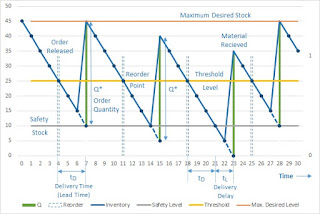
Inventory Policies Inventory policies : inventory definition, stock classification, inventory control issues, continuous and periodic inventory review, order size What Is Inventory? Inventory (stock)  – materials in a supply chain or in a segment of a supply chain, expressed in quantities, locations and/or values, not used at present, but kept for the future use, consumption or sale (Krzyżaniak, 2009).

ABC Analysis

Image
ABC Classification System The method essence Sanders mentioned that objects (items) in the supply chain are not of equal importance. Some are very important, and others are less important. For example, specialized surgical equipment is important for a hospital, while latex gloves are less important ( Sanders, 2013 ). ABC classification is a ranking system for identifying and grouping items in terms of how useful they are for achieving business goals. The ABC system classifies logistics object according to its size, volume, or cash value added to aggregate category of the firm (inventory or overall costs, turnover, etc.). Classifying inventory based on degree of importance allows us to give priority to important objects and manage those with care. It also prevents us from wasting precious resources on managing objects that are of less importance. In the context of inventory control, typically thousands of independent demand items are held in inventory by a company, espe...

Resilient Supply Chain

Image
Resilient Supply Chain Disruptions within Supply Chain Nowadays, organizations perceive Volatility as a systemic condition. They face with demand uncertainty, variability in orders, and maintaining inventory and with many disruptions at any time. When demand rises, organizations try to match it by increasing production or supplies. When demand slumps, they slow down processes to reduce cash outlays for network assets and inventory stocks. Risk events occur not only in the period of instability and often have unprecedented magnitude. The speed of changes is accelerating. During the period, when disruptions are taking place, the global supply chain is spreading impacts instantly among all the connected parties. Some of them may experience severe consequences caused by disruptions. Under these circumstances, the marketing, economic and financial results of organization are deteriorating.

Operations Strategy

Image
Operations Strategy Why we might be interested in Operations Strategy Operations Strategy is one of the most important categories for organizations (firms), which apply Operations Management, aimed at cost-effective adaptation under demand changes. Individual efforts to influence the cost, quality and availability and to reach organization's goals are usually wasted. To start determining Operations Strategy in an organization properly we must know the meaning of a strategy and main features of operations strategy. We have to understand how Operations Strategy links with organizational value and competitive strategy and overall business strategy. What questions sould be asked and considered by firm's managers and experts.

Scalability in Operations Management

Image
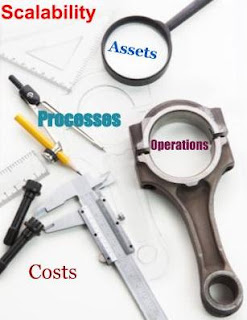
Scalability What is it? It seems that this term, Scalability , is used by managers rarely. However you can meet it within MOOC courses, devoted to business and operations management or manufacturing systems. According to the analysis of publication ( Putnik et al., 2013 ) Scalability within the manufacturing community has started to gain major attention since approximately the year 2000. G. Putnik and co-authors depicted dynamics of number of papers by the search terms ‘scalability AND manufacturing’ in world leading publishers’ collections such, as Elsevier, Springer, T&F, Wiley, Emerald, JSTOR, ACM, and IEEE. You may see that the number increased from about 200 to nearly 1600 over the period 2000-2012. Search results found for two queries and on ScienceDirect.com have showed rise in the quantity of scientific papers (Fig.1). Search terms included all sources by categories Business, Management and Accounting, Decision Sciences, Economics, Econometrics...

SCM categories

Image
Supply Chain Management (SCM) has been developed progressively for several last decades. Researchers had been taking into account many different aspects that gave new categories such, as: Supply Chain Design, Lean SCM, Sustainable SCM and Green SCM. Supply Chain Management Let's take a look at some categories for supply chain management (SCM). But firstly there is a simple definition of supply chain